Craig Cunningham posted at The Wall a nice piece that addresses the tragic and ongoing stupidification of urban poor children who are purportedly being helped by an unceasing regimen of test prep in chain gang schools where teachers learn their scripted lines and students mouth them back (see Kozol's "Confections of Apartheid" in the December Kappan. That is the greatest human tragedy now unfolding before our eyes, an intellectual and emotional genocide of epic proportions in the making.
The other tragedy is, perhaps, more abstract, but goes to the heart of the civic purpose of schools to help sustain the Republic. It is the agenda to privatize American schools, and to use NCLB with its impossible demands to manufacture a widespread failure that a Massachusetts study has shown, for instance, will label as failures over three-quarters of their schools by 2014--unless NCLB is ditched or modified next year when re-authorization comes up.
The requirement that all school children be at grade level in reading and math by 2014 is simply ridiculous. Those who point this out are, nonetheless, accused daily of "the soft bigotry of low expectations." It seems to me that to craft a national policy on the manufactured failure of most American public schools demonstrates clearly the implacable racism bound up in impossible demands of a hidebound ideology. If I had to choose, and I don't (there are more options), I know where I would stand.
If NCLB is not rolled back next year and the probable scenario develops (psychometricians say certain), and a large majority of American schools are clear failures or on the “Federal watch-list” by 2014, then the road to school privatization will be clear sailing. By then, American parents will be shell-shocked and willing to try anything to avoid another one of those Federally-mandated letters telling them that their children are failing because their schools are failing. And state legislatures, broken financially and in spirit by then from the under-funded burdens of NCLB implementation, will be desperate enough to turn the whole effort over to the voucher advocates and the EMOs of an education industry that will be ramped up, ready, and waiting to pounce.
Here is a piece just out in the Monthly Review by Michael Perelman that puts many of the issues in perspective. It is called "Privatizing Education." Read it and ACT.
Tuesday, March 21, 2006


Sunday, March 19, 2006
The hidden purpose of NCLB

No Child Left Behind (NCLB) represents the largest incursion of federal policy (and money) into education in the United States since Sputnik. The Act requires every state in the union to develop standardized measures of whether individual schools (and certain subpopulations with those schools) are making "adequate yearly progress" (AYP). In addition, the Act requires states to spend money in certain specified ways to "help" those schools and subpopulations that are not meeting AYP targets and, after five years, to radically restructure the schools by either putting them under state control, hiring an all-new staff, or shutting the schools down completely.
The US Department of Education provides a comprehensive web site that describes the requirements, philosophy, and desired outcomes of NCLB. The site is not "shy" or uncertain about what NCLB is supposed to do. Citing the bipartisan support with which the Act was passed, the official web site lists NCLB's many explicit purposes:
- Holds schools accountable for the academic achievement of all subgroups
- Closes the achievement gap between disadvantaged students and other students
- Allows parents of students at schools in need of improvement or "persistently dangerous schools" to demand that their school district transport their children to a nearby public school or spent money on supplemental services (tutoring)
- Ensures that taxpayer money is used for programs that "work"
- Combines most federal dollars into block grants which are supposed to ensure local flexibility in how the money is spent
- Allows faith-based organizations to receive federal money to provide supplemental educational services to public school students
- Requires all teachers in core subjects to be "highly qualified" by the end of the current school year; essentially, requiring them to have state certification.
- Funds professional development for teachers "so long as the activities are grounded in scientifically based research."
- Supports the planning, development, and initial implementation of charter schools.
According to the web site, NCLB has already had some positive effects, including:
- "The achievement gaps in reading and math between white and African American 9-year-olds are at all-time lows."
- "No Child Left Behind is improving education in all states." (The site provides a one-page summary of how "NCLB is making a difference in..." for each of the 50 states plus the District of Columbia. Each one-pager includes mention of any increases in test scores between 2002 and 2005 along with some school/district profiles and quotes from local newspapers.)
- "The long-term Nation's Report Card (NAEP) results, released in July 2005, showed elementary school student achievement in reading and math at all-time highs and the achievement gap closing."
- "Students in select urban school districts improving faster than their peers nationwide over the last two years." (But see this NPR report for a completely different take on the same data.)
The official web site makes it clear that NCLB "Benefits Children, Empowers Parents, Supports Teachers and Strengthens Schools"; in sum, "No Child Left Behind Is Working."
Both President Bush and Senator Edward Kennedy (NCLB's chief Democratic sponsor in the Senate) must be pleased with these results. However, all is not happy in the land of bipartisanship. Kennedy has been lamenting for the past few years that the Act has never been fully funded, and that many of the requirements placed on states and school districts are "unfunded mandates." Even conservatives are upset that the Act has been completely ineffective at opening up the prospects of vouchers for private school attendance (one of Bush's original campaign promises), has burdened the states with huge federal "accountability" requirements and bloated the federal department of education while providing little funding, and has been watered down over the years by a department of education more interested in avoiding revolts from the states than in enforcing the Act's provisions.
The Challenge: Ineffective teaching practices and unproven education theories are among the chief reasons children fall behind and teachers get frustrated.
The Solution: Demand that instructional practices be evidence-based, and direct funding so only the best ideas with proven results are introduced into the classroom.
Even though NCLB has been described as being about educational practices, most of the public debate about the Act has avoided questions of "ineffective teaching practices and unproven educational theories" completely. Rather, the debate focuses on whether states should have flexibility in meeting the Act's mandates (especially its Lake Woebegonesque goal of having 100% of all students meeting norms--that is, at or above the 50th percentile as defined by student performance soon after the Act was signed--by 2014), and arguments about whether federal funding is adequate. Certainly NCLB has increased federal funding for education. The real question is whether the activities that it is funding are going to improve the quality of the worst schools.
This, of course, gets us to the real-world of how NCLB affects education across the country. Many schools (especially those with specialized magnet programs or those in affluent communities) already meet NCLB's long-term goal of having 100% of their students above the 50th percentile. (Some of these schools are struggling with how to meet the requirements for certain subpopulations such as special needs students.) The schools primarily affected by the Act are those with substantial populations of lower-income students. The Brookings Institution describes this well:
NCLB seems to have more to do with the composition of its student body than the progress its students were making in the classroom. Schools not making adequate yearly progress in the law's second year had, on average, 40 percent more poor students and a substantially greater share of minorities.
The problem is that the NCLB methodology for measuring school performance does not pay enough attention to the vast differences in students' academic preparation when they arrive at school – differences that have clear consequences for their subsequent test scores. Schools with large numbers of disadvantaged students can be deemed failing for not meeting statewide proficiency targets even if their students are making dramatic progress. Conversely, schools in affluent communities may appear to be effective despite the fact that their students are learning less than the state's average student from one year to the next. (Brookings Institution policy brief)
Because NCLB measures AYP not in terms of a students' actual gains from year to year, but in terms of the percentage of students meeting state averages, the Act affects lower-performing schools much more than it affects higher-performing schools. Indeed, schools that already have the vast majority of their students performing above state averages are pretty much unaffected by NCLB except, again, in the case of some subpopulations. Those schools can go on doing pretty much what they have been doing (whether or not their teaching practices are "ineffective" and their educational theories "unproven"). But lower-performing schools are under the gun to change their teaching practices (and the theories behind them) to focus singlemindedly on helping more of their students to score well on standardized tests of reading and math performance.
The real-world effect of NCLB in those schools is that educational efforts (including those that occur after school) that address other, subsidiary goals (such as increased graduation rates, increased attendance, moral development, the arts, health and physical education, science, social studies--let alone such nebulous goals as independent inquiry, greater self-understanding, democratic citizenship, or global awareness) are marginalized if not completely ignored. (In Illinois, for example, the state found itself with insufficient funds for non-NCLB-mandated activities and so discontinued most testing that isn't connected to reading and math.)
UPDATE 3/27/06: See New York Times of March 26: "Schools Cut Back Subjects to Push Reading and Math," which includes this sentence: "The changes appear to principally affect schools and students who test below grade level."

Which helps us to focus on what may be the most important hidden purpose of NCLB: to reinforce the tendency of lower-income schools (well documented in the work of Jean Anyon and others) to focus on lower-order skills development (the kind of thing that can be measured in multiple-choice tests) through mechanical, rote drill and practice that limits students' individuality and choice. While higher-income schools continue to emphasize creative work, independence, and the application of ideas and concepts (the kinds of skills required for success in professional and intellectual jobs), the lower-income schools are forced by NCLB to concentrate on the kinds of skills and behaviors that are valued primarily in low-end, low-skill occupations. Thus, NCLB can be seen as chiefly aimed not at "leaving no child behind," but at further reinforcing the gap in opportunities between poor and wealthy Americans. This mirrors, of course, the huge increase in the income gap between the poor and the rich, aided in no small measure by President Bush's tax policies.
But even more pernicious is the way that NCLB forces lower-income schools to ignore--to the point in many schools of devoting ZERO instructional time to--helping lower-income students learn about this income gap and about its causes in tax policy, globalization, and corporatization. NCLB leaves low-performing schools (which are, as we've seen, low income schools) ZERO room for teaching low-income students about the causes of economic and political repression. Rather than reading speeches by Martin Luther King or Che Guevara, lower-income students are reciting the apolitical drivel found in the workbooks and "leveled readers" of direct instruction and "scientifically-based" reading programs, while the students in higher-income schools (that is, the kids who are unlikely to resent what they might learn about economic inequality) pursue meaning-based learning (that is, learning that is focused on ideas and concepts, rather than basic skills). Meaning-based learning, it turns out, and its progressive approach to teaching and learning, is the "unproven educational theory" that NCLB is most against, at least when such an approach is used with low income students. This is true, despite lots of evidence (not all of it based on double-blind control-group research) that meaning-based teaching and learning are the best practices for lower-income schools. (See Knapp 1995, summarized here.)
In short, NCLB, by forcing lower-performing schools to focus on "basic skills," is reinforcing the huge gap in higher-order thinking skills that already exists between most low income students and most high income students. The initial cause of these thinking gaps has surely more to do with experiences in the home and communities than with race, ethnicity, or political point of view. But the schools, by differentially reinforcing this thinking gap, are unwittingly participating in the oppression of the lower classes, which is likely to increase even further their alienation from society and the ease with which President Bush's corporate friends can continue to manipulate and repress them.
Those of us who see the collateral effects of NCLB are most likely people who have already benefited from an education that has enabled us to look at the big picture and form judgments about whose interests are being served by which policies on a local, national, and international level. That sort of education (learning to think and analyze complex phenomena independently) has historically been denied to lower income populations. NCLB just makes this thinking gap into federal policy.
Unfortunately, most of the victims of this policy don't know enough to complain.
Thursday, March 16, 2006
The "Sphere" of Sophistication
Aaron proposes that theorists can be judged for their "sophistication" by the extent to which they embrace "contention," "texture," and "reality." The gist of his suggestions, and the diagram, is that theories are more sophisticated when they are more complex and elaborated, when they embrace the convoluted nature of reality, and when they incorporate or at least acknowledge many alternative theories.
This view, I believe, represents the mainstream contemporary beliefs of most people who theorize about research methodology. It fully accepts the increasingly common view among scholars in the 20th century that anything simple must be guided by ideology rather than by a "true" understanding of reality, by "careful" consideration of alternative viewpoints, or by a "diligent" attention to complexities. The implication is that those who propose simple theories are themselves simple-minded, and most likely motivated by something other than research, for example by religious beliefs or wishful thinking.
There are, of course, people on the other side of this debate: people who believe that there are simple, unitary, and strikingly clear explanations for reality, and that those who insist on convoluted theories are simply caught up in their own academic gobbledygook and a refusal to acknowledge what they know in their hearts (if only they'd listen to them) to be true.
(Need I make explicit allusion here to one example of how this debate plays out; namely, between the policy makers in the current administration who insist that all educational programs be supported by double-blind controlled experiments--i.e. by simple data and analysis--and those post-modernist theorists and methodologists who insist that much of reality cannot possibly be understood using such simple methods? Well, I will make such an allusion anyway!)
While--as a tweedy intellectual academic myself--I usually side with the post-modernist people who seek complexity and convolution, one comment of Aaron's caught my attention. He wrote:
I have spent the last few days thinking about what this schematic would look like if the axes curved toward one another as Aaron describes. It's difficult to visualize (mainly becuase there are THREE axes--hence a three-dimensional space: hard to visuallize, let alone draw. But one thing is clear: if the axes curve toward one another, then eventually, at some point "out there," they would intersect.
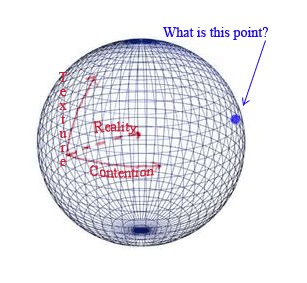 Because I can't draw anything truly three-dimensional, I've chosen to "sort of" represent what this would look like with curved axes. I've drawn two of the axes on the surface of a sphere, with the third axis sort of tending toward the center of the sphere. Then, I've imagined that the three axes eventually intersect at some point on the other side of the sphere. Thus:
What this leads me to imagine is, What the heck is that point of intersection on the other side? Is it, perhaps, the point-of-view of someone who holds that the best theory is one in which texture, contention, and reality finally come together into a grand theory that supercedes all of the silly vain attempts of intellectuals to strive toward more and more complexity, that is, the unified field theory (if you will) that embraces unity, simplicity, and universality?
What if Aaron's notions of sophistication are only half the story, that once a theory has incorporated all that complexity and contention and convolution that eventually it evolves into something truly elegant? Maybe "sophistication" cannot be measured purely by complexity? Or, maybe what Aaron is really saying is that he wants his STUDENTS to embrace complexity so that they eventually learn to listen to their hearts?
Occam's Razor, anyone?
This view, I believe, represents the mainstream contemporary beliefs of most people who theorize about research methodology. It fully accepts the increasingly common view among scholars in the 20th century that anything simple must be guided by ideology rather than by a "true" understanding of reality, by "careful" consideration of alternative viewpoints, or by a "diligent" attention to complexities. The implication is that those who propose simple theories are themselves simple-minded, and most likely motivated by something other than research, for example by religious beliefs or wishful thinking.
There are, of course, people on the other side of this debate: people who believe that there are simple, unitary, and strikingly clear explanations for reality, and that those who insist on convoluted theories are simply caught up in their own academic gobbledygook and a refusal to acknowledge what they know in their hearts (if only they'd listen to them) to be true.
(Need I make explicit allusion here to one example of how this debate plays out; namely, between the policy makers in the current administration who insist that all educational programs be supported by double-blind controlled experiments--i.e. by simple data and analysis--and those post-modernist theorists and methodologists who insist that much of reality cannot possibly be understood using such simple methods? Well, I will make such an allusion anyway!)
While--as a tweedy intellectual academic myself--I usually side with the post-modernist people who seek complexity and convolution, one comment of Aaron's caught my attention. He wrote:
(One key limitation of this picture is the straightness of the different axes. In actuality, as one moves out along the axis of “texture,” for example, one necessarily moves closer to both other axes, since teasing out complexities will increasingly require reference to the writings of others and to unexplained aspects of the context under examination. Thus, imagine that all of these axes curve towards each other (which I don’t know how to do in my simple drawing program.)
I have spent the last few days thinking about what this schematic would look like if the axes curved toward one another as Aaron describes. It's difficult to visualize (mainly becuase there are THREE axes--hence a three-dimensional space: hard to visuallize, let alone draw. But one thing is clear: if the axes curve toward one another, then eventually, at some point "out there," they would intersect.
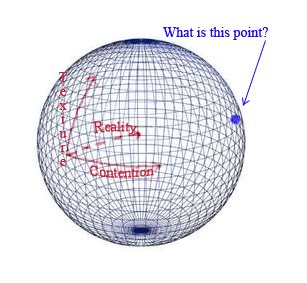 Because I can't draw anything truly three-dimensional, I've chosen to "sort of" represent what this would look like with curved axes. I've drawn two of the axes on the surface of a sphere, with the third axis sort of tending toward the center of the sphere. Then, I've imagined that the three axes eventually intersect at some point on the other side of the sphere. Thus:
What this leads me to imagine is, What the heck is that point of intersection on the other side? Is it, perhaps, the point-of-view of someone who holds that the best theory is one in which texture, contention, and reality finally come together into a grand theory that supercedes all of the silly vain attempts of intellectuals to strive toward more and more complexity, that is, the unified field theory (if you will) that embraces unity, simplicity, and universality?
What if Aaron's notions of sophistication are only half the story, that once a theory has incorporated all that complexity and contention and convolution that eventually it evolves into something truly elegant? Maybe "sophistication" cannot be measured purely by complexity? Or, maybe what Aaron is really saying is that he wants his STUDENTS to embrace complexity so that they eventually learn to listen to their hearts?
Occam's Razor, anyone?
Subscribe to:
Posts (Atom)


